17 July 2019
Real vs fake motorcycle crash helmets
05 November 2018
Why deepfake videos are a real threat to elections and society
30 January 2017
Please don't propagate fake news
23 April 2018
Martin Lewis to sue Facebook - to stop fake / scam adverts
Today, in an individual capacity, he will issue High Court proceedings for a campaigning defamation lawsuit against Facebook and will be seeking exemplary damages. This is not being done for personal gain – he pledges any and all money paid out to him will be donated to anti-scam charities.
Within the last year, the social media site (Facebook) has published over 50 fake Martin Lewis adverts (sample images here), which are regularly seen, likely by millions of people, in the UK. These adverts are often for scams. Many have big pictures of Martin and his name, alongside a raft of false promises or endorsements – some then link on to fake articles which continue the theme.
30 April 2026
Nearly half of UK businesses pwned last year as phishing keeps doing the job like it's 2005
Nearly half of UK businesses are still getting breached, and in many cases, the attacker's big breakthrough is an employee clicking "sure, why not" on a fake login page.
The UK government's latest Cyber Security Breaches Survey, released on Thursday, puts the hit rate at 43 percent of businesses and 28 percent of charities reporting a cyber incident in the past year, equating to approximately 612,000 UK businesses and 57,000 UK charities, numbers that have barely budged since the last time it asked.
Most of these breaches do not start with anything especially cutting-edge. Phishing leads "by far," usually via impersonation emails that send staff to fake login pages or get them to click links, open attachments, or hand over sensitive information.
Everything else barely gets a look-in. Around 85 percent of businesses that reported a breach or attack said it involved phishing, leaving malware, ransomware, and unauthorized access trailing some distance behind.
03 April 2025
Five VPN apps in the App Store had links to Chinese military
A subsidiary of one of the Chinese companies behind the apps is currently hiring for a role in “monitoring and analysing platform data,” with a familiarity with American culture listed as a job requirement …
Virtual Private Network (VPN) apps are designed to protect the privacy of internet usage, protecting against man-in-the-middle attacks using fake public Wi-Fi hotspots, as well as ensuring your ISP or mobile carrier can’t track the websites you visit.
Additionally, VPNs can be used to circumvent geoblocks on anything from streaming video services to content banned by a country’s government.
However, VPNs are only as trustworthy as the companies behind them. A fake VPN can expose all your browsing data to its developer.
15 November 2022
Ofcom rules to fight fake number fraud
Phone users will be better protected against scammers using fake phone numbers, under new rules announced today by Ofcom.
Scams are a widespread problem – 41 million people have received a suspicious call or text in the last three months. A common tactic used by criminals to defraud victims is to imitate – or ‘spoof’ – the phone numbers of legitimate organisations, like banks and Government departments.
To help combat this problem, we are strengthening our rules and guidance to require all telephone networks involved in transmitting calls – either to mobiles or landlines – to identify and block spoofed calls, where technically feasible. This will make it harder for scammers to use spoofed numbers.
We have also today issued new guidance to phone companies on how they can prevent scammers from accessing valid phone numbers. This sets out clear expectations for providers to make sure they run ‘know your customer’ checks on business customers.
04 July 2018
Record number of fake HMRC websites deactivated over past year
06 November 2017
Downloaded WhatsApp from Google Play recently? Better read this!
25 August 2017
Facebook Messenger Spam Leads to Adware, Malicious Chrome Extensions
20 October 2023
Indian authorities raid fake tech support rings after tipoff from Amazon and Microsoft
The Bureau shared news of a Thursday operation that saw it conduct 76 searches in relation to five cases.
The Bureau stated its effort "was conducted in collaboration with national and international agencies, alongside private sector giants," and described two of its targets as international tech support fraud scams that "impersonated a global IT major and a multinational corporation with an online technology-driven trading platform."
The alleged scammers operated call centers in five regions of India and "systematically preyed on foreign nationals, masquerading as technical support representatives" for at least five years.
The scammers sent users pop-up messages that appeared to come from multinational companies and advised of PC problems – with a toll-free number at which assistance could be had.
Victims who called the fakers had their PCs taken over, and were charged hundreds of dollars for a "fix".
22 September 2017
Equifax staff direct customers to fake website. It gets even worse for the beleaguered company...
30 July 2018
Fake news 'crowding out' real news, MPs say
03 March 2023
ChatGPT - probably ain't the technological "solution" that you've been waiting for
“I’m sorry Dave, I’m afraid I can’t do that.” These were the words that introduced most people in my generation to the concept of an AI gone rogue; HAL 9000 in the classic science fiction movie 2001: A Space Odyssey, eventually went insane singing the lyrics of Daisy, Daisy as it slowly blinked its ominous red eye before finally shutting down permanently.
To be clear, HAL 9000 is not the only AI ever to go rogue in popular science fiction - literature is littered with such stories, but there was a certain relatability and poignancy in the HAL 9000 scenario as throughout the movie HAL had been not just useful but one could even say friendly, and was as much part of the cast as the real actors. For me, the scene will never be forgotten because of the sense of disbelief that an AI would cause or attempt to cause harm to a human - after all, we had heard of Asimov’s laws of robotics, and assumed AIs would be safe because they would follow those laws.
The problem is, just as HAL 9000 was science fiction, so were Asimov’s works and as such relying on fictional laws in the context of the real world and how robotics and AIs are being developed and deployed, is folly. We cannot assume that real-world models are being trained based on such fictional laws and the reality is, they are not.
Towards the end of 2022, OpenAI opened up its non-intelligent, response-predicting large language model known as ChatGPT to the general public, and it quickly became an internet sensation due to its uncanny ability to mimic human speech and nuance.
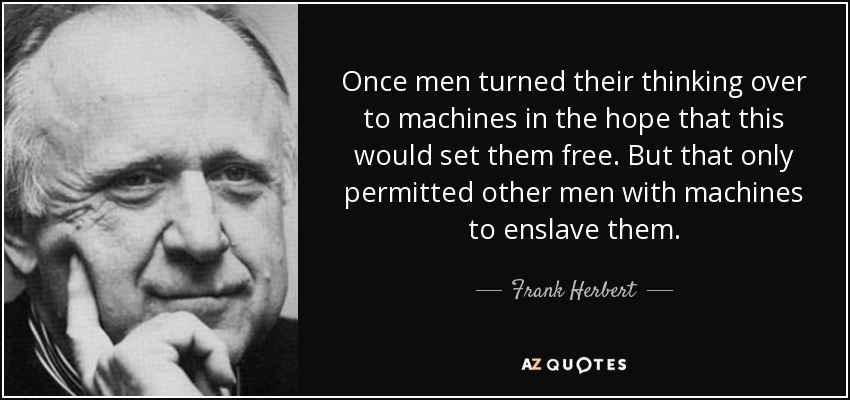
Here's a quote from one of my favourite books - Dune by Frank Herbert: 
21 June 2017
Before you repost "that" story: check that it is true first!
23 November 2017
Facebook's action plan against foreign (Russian) election interference
11 October 2017
Malicious iOS app popup windows could be stealing your Apple ID
- If you get a popup asking for a password inside an app, hit the home button. If you can quit back to the home screen it's not a legitimate request. Real system dialogs that ask for passwords are run as a separate process and can't be quit in that fashion.
- Treat password requests inside apps like you would a link in an email—don't use it. Instead, open the Settings app and put the password in there, similar to going directly to a website that wants you to verify your information.
- Don't type anything into a password-requesting popup. Even if you press the cancel button the information has already been captured.