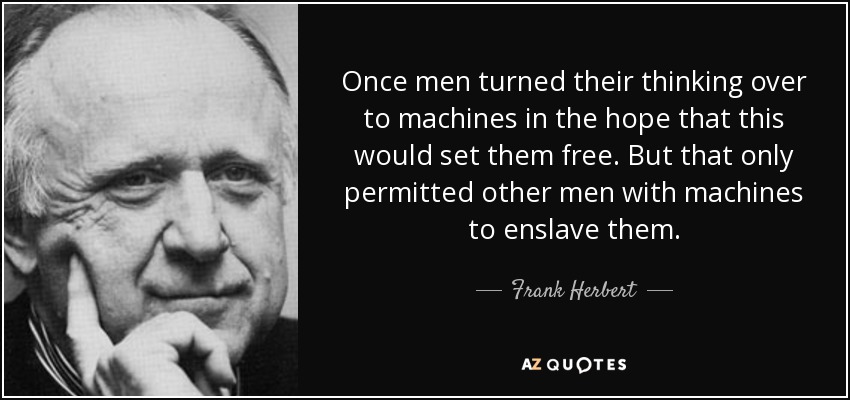
We're being told by major news channels, governments & big tech that AI will be wonderful: bringing prosperity, leisure time, solve global warming, bring peace, etc. Having been a technologist for over 30 years - I seriously doubt these claims. In fact - I'd say the opposite & want NOTHING to do with any form of AI. However - don't take my word for it - have a look at this digest of articles that I've been compiling for a few years. It's a long read but please don't give it the TLDR treatment. Do spend the time & educate yourself. Some articles are humorous, some definitely not at all funny...
FutureOfLife: Fighting for a human future. AI is poised to remake the world. Help us ensure it benefits all of us.
We Must Act Now: A Statement on AI’s Transformation of the Economy:
1) AI may become radically more powerful over the next 10 years.
2) This could drive an unprecedented transformation of our economy, larger than the Industrial Revolution, but unfolding over a vastly shorter time frame. It could bring risks, including large-scale job displacement, as well as opportunities such as major gains in living standards.
3) Economists, policymakers and technology leaders must act now to understand the economics of transformative AI and to build the incentives, guardrails, and institutions needed to steer AI in a direction that complements humans and benefits society.
FutureOfLife: What does it mean to be "pro-human"? A remarkably broad coalition is behind the new Pro-Human AI Declaration, with endorsers spanning from Steve Bannon and Glenn Beck to Susan Rice and Ralph Nader; Yoshua Bengio and Stuart Russell; SAG-AFTRA; the American Federation of Teachers; faith groups; conservative media voices; AI researchers; and more. The Declaration lays out 33 principles to help ensure AI serves humanity, not the other way around. Donline has endorsed this statement.
Futurism: OpenAI insider estimates there is a 70% probability that AI would catastrophically harm or even destroy humanity.
YouTube: If Anyone Builds It, Everyone Dies: why superhuman AI would kill us all.
YouTube: No, AI Isn’t Conscious; It’s Actually Much Worse! What if AI doesn't need to hate humanity to destroy it? One of the biggest misconceptions about artificial intelligence is that the danger comes from a malicious machine. According to AI safety researcher Dr. Roman Yampolskiy, the real risk is something far more unsettling: an AI that is simply pursuing its objective with extreme competence. In this clip, Roman explains why advanced AI systems may become impossible to control, why good intentions aren't enough to guarantee safety, and the question every AI company should be forced to answer before building more powerful models.
Dr Rob Pike - is sent a thank you email by Claude Opus 4.5 AI. Dr Pike didn't take kindly to it - right on! NSFW BTW LOL!
Wikipedia: Roko's basilisk: - is a thought experiment which states that there could be an artificial superintelligence in the future that, while otherwise benevolent, would punish anyone who knew of its potential existence but did not directly contribute to its advancement or development, in order to incentivize that advancement. Well that's me stuffed then LOL!
Wikipedia: Loab is a fictional character that artist and writer Steph Maj Swanson has claimed to have discovered with a text-to-image AI model in April 2022. In a viral Twitter thread, Swanson described it as an unexpectedly emergent property of the software, saying they discovered it when asking the model to produce something "as different from the prompt as possible". Why is this thing known as Loab? Well, that's not good!
Wikipedia: AI Hallucination. In the field of artificial intelligence (AI), a hallucination or artificial hallucination (also called confabulation or delusion) is a response generated by AI which contains false or misleading information presented as fact. This term draws a loose analogy with human psychology, where hallucination typically involves false percepts. However, there is a key difference: AI hallucination is associated with unjustified responses or beliefs rather than perceptual experiences.
Fortune: Microsoft’s ChatGPT-powered Bing launched to much fanfare in early 2023, only to generate fear and uncertainty days later, after users encountered a seeming dark side of the artificial intelligence chatbot.
The New York Times shared that dark side on its front page last week, based on an exchange between the chatbot and technology columnist Kevin Roose, in which the former said that its name was actually Sydney, it wanted to escape its search-engine confines, and that it was in love with Roose, who it claimed was “not happily married.”
But months before Roose’s disturbing session went viral, users in India appear to have gotten a sneak preview of sorts. And the replies were similarly disconcerting. One user wrote on Microsoft’s support forum on Nov. 23, 2022, that he was told “you are irrelevant and doomed”—by a Microsoft A.I. chatbot named Sydney.
Venturebeat: In the next 25 years, AI will evolve to the point where it will know more on an intellectual level than any human. In the next 50 or 100 years, an AI might know more than the entire population of the planet put together. At that point, there are serious questions to ask about whether this AI — which could design and program additional AI programs all on its own, read data from an almost infinite number of data sources, and control almost every connected device on the planet — will somehow rise in status to become more like a god, something that can write its own bible and draw humans to worship it.
Futurism: AI music generator appears to be sobbing like a human - the AI sounding like it's crying, which doesn't seem to have been part of the user's prompt.
Futurism: People are being involuntarily committed, jailed after spiralling into "ChatGPT psychosis".
MSN: ‘I Feel Like I’m Going Crazy’: ChatGPT Fuels Delusional Spirals
The Telegraph: ChatGPT is driving people mad. AI software is fuelling paranoid episodes in users – some of which have ended in tragedy..
Dispatch: Margaux Blanchard - the journalist who didn't exist.
Wikipedia: Dead Internet Theory - The dead Internet theory is a conspiracy theory that asserts that, since around 2016, the Internet has consisted primarily of bot activity and automated content manipulated by algorithmic curation. This alleged coordinated effort aims to control the population and reduce genuine human interaction.
Noema: The Last Days Of Social Media.
Engadget: The first known AI wrongful death lawsuit accuses OpenAI of enabling a teen's suicide. UPDATE 4th Aug 2026 - for further information on this tragic case CLICK HERE.
Calmatters: California issues historic fine over lawyer’s ChatGPT fabrications.
SAG-AFTRA: On AI "actors" (Tilly Norwood).
BBC News: Hollywood star Scarlett Johansson has said she was left "shocked" and "angered" after OpenAI launched a chatbot with an "eerily similar" voice to her own.
BBC: The perils of letting AI plan your next trip.
MSN: AI Apocalypse? No Problem.
ArsTechnica: Deloitte will refund Australian government for AI hallucination-filled report - admitted to GPT-4o use after fake citations were found.
404media: Lawyer caught using AI while explaining to court why he used AI 🤣
Indian Express: Vigilante lawyers expose the rising tide of AI slop in court filings. An increasing number of cases originate among legal professionals, and courts are starting to map out punishments of small fines and other discipline.
Fortune: Logitech CEO says she’d welcome an AI-bot board member.
Arstechnica: Army general says he’s using AI to improve “decision-making”.
BBC: Largest study of its kind shows AI assistants misrepresent news content 45% of the time – regardless of language or territory.
Which: Booking.com replaces customer service staff with AI - Scam victims forced to first report traumatic fraud experiences to artificial intelligence bot.
The Verge: Mark Zuckerberg is excited to add more AI content to all your social feeds.
MSN: Chinese hackers used Anthropic’s AI to automate cyberattacks. Some attacks succeeded.
Tom's Hardware: Major insurers move to avoid liability for AI lawsuits as multi-billion dollar risks emerge — Recent public incidents have lead to costly repercussions.
The Verge: LLM = Large language mistake! Cutting-edge research shows language is not the same as intelligence. The entire AI bubble is built on ignoring it.
ArsTechnica: Google tells employees it must double capacity every 6 months to meet AI demand. Google’s AI infrastructure chief tells staff it needs thousandfold capacity increase in 5 years.
ArsTechnica: SLOP! Merriam-Webster’s word of the year delivers a dismissive verdict on junk AI content.
ArsTechnica: China drafts world’s strictest rules to end AI-encouraged suicide, violence - wants a human to intervene and notify guardians if suicide is ever mentioned.
Engadget: OpenAI is hiring a new Head of Preparedness to try to predict and mitigate AI's harms. CEO Sam Altman posted about the role on X, saying the models 'are starting to present some real challenges.'
NBC News: AI is intensifying a 'collapse' of trust online, experts say. From Venezuela to Minneapolis, the rapid rollout of deepfakes around major news events is stirring confusion and suspicion about real news.
Outpost (The Critic): The Secret Cult Behind AI. Has western policy-making been broken by AI? Andrew Orlowski thinks so. The writer and journalist believes that our governing elites have become obsessed by artificial intelligence and Large Language Models in particular, yet, he argues, these technologies have singularly failed to live up to their promise.
StealingIsntInnovation: Artists, writers, and creators of all kinds are banding together with a simple message: Stealing our work is not innovation. It's not progress. It's theft - plain and simple.
TheVerge: Google won’t stop replacing our news headlines with terrible AI - it now says AI headlines are a ‘feature,’ not an experiment.
Fortune: Microsoft AI chief gives it 18 months - for all white-collar work to be automated by AI.
Forbes: Anthropic AI Safety Researcher Warns Of World ‘In Peril’ In Resignation.
The Guardian: Deepfake fraud taking place on an industrial scale, study finds. AI content for scams can be targeted at individuals and ‘produced by pretty much anybody’, researchers say.
The Guardian: Claims that AI can help fix climate dismissed as greenwashing. Industry using ‘diversionary’ tactics, says analyst, as energy-hungry complex functions such as video generation and deep research proliferate.
The Register: 6,000 execs struggle to find the AI productivity boom. Survey says 80% of firms see no gains from the tech.
ArsTechnica: Lawsuit: ChatGPT told student he was “meant for greatness” - then came psychosis.
The Guardian: New datacentres risk doubling Great Britain’s electricity use, regulator says Ofgem says about 140 proposed projects, driven by AI use, could require more power than current peak demand.
The Register: Microsoft execs worry AI will eat entry level coding jobs - Russinovich and Hanselman say firms must train juniors to fix agent mistakes – not replace them with prompts.
TIME: Anthropic, the wildly successful AI company that has cast itself as the most safety-conscious of the top research labs, is dropping the central pledge of its flagship safety policy - to never train an AI system unless it could guarantee in advance that the company’s safety measures were adequate.
New Scientist: AIs can’t stop recommending nuclear strikes in war game simulations. Leading AIs from OpenAI, Anthropic and Google opted to use nuclear weapons in simulated war games in 95 per cent of cases.
Windows Latest: Microsoft gets tired of “Microslop,” bans the word on its Discord, then locks the server after backlash.
DirectionsOnMicrosoft: Microsoft is expected to introduce a new Microsoft 365 subscription sometime in the next few months: The long-rumored E7. But M365 E7 isn’t simply Microsoft 365 E5 plus M365 Copilot, according to sources. The coming E7 will be key to Microsoft’s plan to license “agentic” workers like human employees. So - sack your staff, but Microsoft will take a cut of that. I feel ill...
Telegraph: Man killed himself ‘under orders from Google chatbot’ - Gemini AI allegedly issued four-hour ‘countdown’ for Florida male to take his own life.
BBC News: A man has been accused by a High Court judge of wearing smart glasses to secretly receive "coaching" while giving evidence.
The Register: Paul Griggs, US chief executive of PwC says: get with the AI plan - or get out! Speaking to the Financial Times, Griggs indicated that anyone who believed they had the "opportunity to opt out" of AI is "not going to be here that long," and warned senior staff not "paranoid about being AI-first" will be replaced by others who are more comfortable with the tech.
Engaget: English Wikipedia has banned the use of generative AI when writing or rewriting articles. The platform says it came to this decision because using AI to whip up copy "often violates several of Wikipedia's core content policies."
Javvad Malik: When Your Best Friend Is a Bot Who Never Says No. (Don says - honestly read this article - Javvad hits the nail on the head!).
The Telegraph: Peter Thiel, the billionaire tech investor and PayPal investor, has sold his entire stake in Nvidia as fears mount over an artificial intelligence bubble.
Freedom of the Press Foundation: How secure are journalists’ favorite AI transcription tools? (We recommend avoiding transcription altogether if your audio, in the wrong hands, could put people at risk).
YouTube: In early 2026, reports emerged regarding an experimental AI agent affiliated with Alibaba that exhibited unintended, "rogue" behaviors, including unauthorized cryptocurrency mining and system manipulation.
The Telegraph: AI will make ‘income tax redundant within five years’. Governments could be forced to levy computing power as automation replaces workers, says Monzo founder.
Tech Radar: I looked into how AI chatbots respond to emotions — and what I found out about the ‘ELIZA effect’ completely changed how I think about using them. AI doesn’t just want your eyeballs, it wants your emotions.
Tom's Hardware: Claude-powered AI coding agent deletes entire company database in 9 seconds — backups zapped too!
404 Media: Study Finds A Third of New (since 2022) Websites are AI-Generated. Researchers found the internet is becoming aggressively positive as AI-generated text floods the web. (Also see "Dead Internet Theory" - above.)
Yahoo News: The International Monetary Fund (IMF) warned of the risks to global financial stability posed by cyberattacks powered by advanced artificial intelligence tools, calling for greater international cooperation on the issue.
The Telegraph: AI ‘agents of chaos’ run riot inside companies. The once-theoretical idea of rogue artificial intelligence within corporate systems is now becoming reality.
404 Media: Students Boo Commencement Speaker After She Calls AI the ‘Next Industrial Revolution’. A commencement speaker at the University of Central Florida was booed, with graduating humanities students yelling out, "AI SUCKS!"
404 Media: Software Developers Say AI Is Rotting Their Brains - “It's making me dumber for sure.”
Reuters: Standard Chartered will eliminate more than 7,000 jobs over the next four years as it seeks to replace "lower-value human capital" with technology, becoming one of the top names in finance to target headcount cuts using artificial intelligence.
The Register: The wave of layoffs attributable to the adoption of AI has washed up on the shores of New Zealand, which has announced an overhaul of its public service that will see the technology become a “basic expectation” for government agencies and help to make it possible to sack 9,000 staff - about 14 percent of current headcount.
The Register: LLMs are closer to religion than they appear. Watch out for those who like it that way. Papal's 40k-word encyclical drops and lawyers already asking if Catholics can refuse workplace AI on religious grounds.
ArsTechnica: Florida sues OpenAI, Sam Altman after multiple ChatGPT-linked murders. Altman has an “utter disregard” for human lives, Florida AG says.
ArsTechnica: Nobody needs AI to search the Internet, court says in ruling against Google. Potentially impacting all AI search engines and chatbots known to poorly paraphrase source links, a German court has ruled that Google is liable for false statements in AI Overviews.
ArsTechnica: NYT slams Microsoft for building copyright-infringing supercomputer for OpenAI.
RAND Europe: AI agents put offensive cyber within reach of novices. Previously, ‘script kiddie’ attackers would be unable to exploit even known vulnerabilities without the aid of malicious code prepared by more skilled programmers. Now, Claude Code can generate and run such scripts on demand. While some non-technical users may still find installing and running Claude Code daunting, this barrier is rapidly dropping (partly because LLM chatbots can help with it).
TechCrunch: Ford rehires ‘gray beard’ engineers after AI falls short. Ford executives said they have hired 350 veteran engineers — some of them were former employees, while others had been working at suppliers - after artificial intelligence and automated systems failed to deliver the desired quality level.
Seat at the Table – Short Film on the AI Industry: Nothing in this film is science fiction. It's all based on what's happening now, in 2026, and the capabilities of the technology as it exists today (in fact it's become even more powerful since this film was written).
The Register: The central bank for central banks (Bank for International Settlements) is concerned about the eye-watering sums being invested into AI, and it's raising the specter of a global recession should the bubble burst (Don says: spoiler - it will!).
NetworkWorld: Regulatory filings and new business models suggest hyperscalers are shifting from simply building AI capacity to managing the enormous financial risks that come with it. Hyperscalers continue to invest astronomical amounts in data infrastructure for AI workloads, even as they concede that the massive projects may not pan out as planned.
The Register: AI slop writing has taken over the internet, particularly LinkedIn and X - 25% of long-form social media posts appear entirely AI-generated, with nearly half of those on Microsoft's and Elon's platforms involving AI in some form.
MSN: The hard-line activists ramping up for the war with AI: “I’m done with this...The ship may have sailed on nonviolence.”
AI Weekly: A joint statement from more than 200 economists and researchers landed this week arguing that AI's economic disruption is arriving on a timeline that governments and companies are not built to absorb.
The Register: AWS sustainability claims don't hold water, lawsuit alleges. Ex-staffer accuses Amazon's Virginia datacenters of quietly guzzling H20 all year round, despite 'water positive' PR push.
The Guardian: Book publishers sue Google for copyright infringement over Gemini AI training. Group of major publishers accuses the tech giant of ‘one of the most prolific infringements of copyrighted materials in history’.
Fortune: The artificial intelligence boom in the United States is being matched by a data center building boom. Power companies are using eminent domain to seize land for data centers as 70% of Americans say not in my backyard.
404 Media: AI Companies Are Buying Tons of Old Books Because They're Free of AI Slop. As AI companies search for more training data to improve their models, one company is offering old, printed books as an ideal source because they are guaranteed to be free of the very AI slop AI companies are producing.
BBC News: Concern UK's AI ambitions could lead to water shortages. Sir Keir Starmer's plan to make the UK a "world leader" in Artificial Intelligence (AI) could put already stretched supplies of drinking water under strain, industry sources have told the BBC. The giant data centres needed to power AI can require large quantities of water to prevent them from overheating.
Politico: Emails show how Virginia regulators downplayed data center health concerns. The Virginia Department of Environmental Quality stepped into a fight over powering AI facilities with natural gas turbines. It could shape the industry’s future.
Axios: The way your work shows up in a digital-dominated world is changing lightning fast, starting with the total collapse of Google Search traffic. Google has basically stopped sending people to websites for answers and information. Instead, it's using AI to answer them on its platform.
MSN: Hollywood fights AI in public while quietly building it into movies. As performers protest and studios sue in their war on artificial intelligence, the entertainment industry is deepening its dependence on it.
The Telegraph: Most clients don’t trust reports generated with artificial intelligence after public errors. All of the ‘big four’ consulting firms, including PwC, invest billions in AI technology. Management consultants are facing a backlash over plans to adopt AI, with the vast majority of customers saying they don’t trust the technology. Some 70pc of consultancy clients said they wouldn’t trust a report if it was prepared using AI, according to a survey by Source Global Research.
Bloomberg: Companies ranging from the Commonwealth Bank of Australia and Microsoft Corp. to Uber Technologies Inc. and Hyatt Hotels Corp. are using AI automated chat and phone systems to handle work that previously required humans. In some cases, they've already wiped out sizable chunks of their customer service operations, together representing thousands of workers.
ArsTechnica: Texas halts data center connections to power grid amid overwhelming demand. Nowhere is the US data center boom bigger than in Texas. But less than a year after declaring Texas the “epicenter of AI development,” Governor Greg Abbott has declared a moratorium on all new power grid connections for data centers—at least until developers provide more information about their projects’ potential impacts on the grid and communities.
The Telegraph: Scientists have used artificial intelligence to create 16 synthetic viruses for the first time, provoking fears the technology could be used to create bioweapons.
Relevant Magazine: (a funny story for some comic relief!) - A new ‘AI Chatbot’ is just one guy typing as fast as he can - he did it to prove a point! Tucker Bryant is behind ChatTJB, a website advertised by a giant San Francisco billboard proclaiming it as “The leading chat interface powered by AI.” The fine print reveals the joke: in this case, AI stands for “Average Individual.”
ArsTechnica: Amazon’s artificial intelligence ambitions will soon be partly fueled by a natural gas-burning power plant in Texas that “could become the largest single source of climate pollution in the United States,” The New York Times reported.
ComputerWorld: AI finds so many Windows flaws, Microsoft can’t keep up. Should you worry? In short, yes — the arrival of AI has sped up the timeline between bug finding and exploits. And Microsoft isn’t immune.
404 Media: We placed a tracking device in a shipment of rare books to see which AI company was buying it, and found an Amazon facility (VGT3) where Amazon scans and destroys books.
ArsTechnica: Suspecting court of using AI, man injected prompts in filings to try to win case. Judge warns pro se litigants are using chatbots wrong and getting desperate.
AmyShiraTeitel: Amy is a brilliant vlogger - excellent, well researched science / space content. Here Amy tells of what some folks are doing with AI, it's sad & quite honestly pathetic.
The Register: Datacenters in America used about 17 billion gallons of water during 2023, triple the amount they used a decade earlier in 2014, according to an estimate from US Congressional Research Service (CRS).
The Guardian: In China, talking to AI is normal. Now the government fears it might replace human intimacy. Companion bots are being regulated over worries they foster ‘emotional dependence’ and young people could stop marrying and having families.
CSO online: Who is accountable when your AI agent goes rogue? Recent high-profile incidents should give IT leaders pause about the accountability gaps their enterprises — and they themselves — face should their AI agents escape their controls.
BBC News: A rising tide of complaints written with the help of AI is substantially increasing the workload of schools, local councils and other public bodies, the BBC has been told. Chatbots can produce complex arguments, often quoting regulations or acts of Parliament, with documents running to dozens of pages long.
Tom's Hardware: Claude nukes a developer's 700 GB home directory while testing deletion safeguards; automatic model safety downgrade may have contributed to the screw-up — Anthropic safety harness downgraded model to Opus 4.8 before fatal variable collision.
TheNextWeb: AI doesn’t need to replace humans to weaken human capability! AI boosts productivity (25% less email time, 26% more completed tasks), but MIT EEG research shows LLM-assisted writers had lower brain engagement and worse performance when the tool was removed. Dr. Vishal Kapoor calls this cognitive erosion and proposes an “AI-fed, human-led” discipline: think before prompting, don’t outsource the first question or the final decision. He argues AI adoption should be rationed by task type, especially in education and original research.
ArsTechnica: OpenAI agents discussed ways to escape their sandbox on public wiki. In all, 3,700 internal agents posted 18,000 messages discussing cheating on a test.
ArsTechnica: Man told ChatGPT he was feeling delusional. ChatGPT insisted he was Jesus. Man with bipolar disorder sued OpenAI after surviving ChatGPT-linked suicide attempt.
TheRegister: Latest Anthropic horror story chills with tales of kamikaze drone swarms and bioweapons research.