Showing posts sorted by relevance for query hal. Sort by date Show all posts

03 March 2023

ChatGPT - probably ain't the technological "solution" that you've been waiting for


“I’m sorry Dave, I’m afraid I can’t do that.” These were the words that introduced most people in my generation to the concept of an AI gone rogue; HAL 9000 in the classic science fiction movie 2001: A Space Odyssey, eventually went insane singing the lyrics of Daisy, Daisy as it slowly blinked its ominous red eye before finally shutting down permanently.

To be clear, HAL 9000 is not the only AI ever to go rogue in popular science fiction - literature is littered with such stories, but there was a certain relatability and poignancy in the HAL 9000 scenario as throughout the movie HAL had been not just useful but one could even say friendly, and was as much part of the cast as the real actors. For me, the scene will never be forgotten because of the sense of disbelief that an AI would cause or attempt to cause harm to a human - after all, we had heard of Asimov’s laws of robotics, and assumed AIs would be safe because they would follow those laws.

The problem is, just as HAL 9000 was science fiction, so were Asimov’s works and as such relying on fictional laws in the context of the real world and how robotics and AIs are being developed and deployed, is folly. We cannot assume that real-world models are being trained based on such fictional laws and the reality is, they are not.

Towards the end of 2022, OpenAI opened up its non-intelligent, response-predicting large language model known as ChatGPT to the general public, and it quickly became an internet sensation due to its uncanny ability to mimic human speech and nuance.

However: It not only told everyone I died but tried to fake my obit. Are we ready for this machine-driven future?  Why ChatGPT should be considered a malevolent AI – and be destroyed.

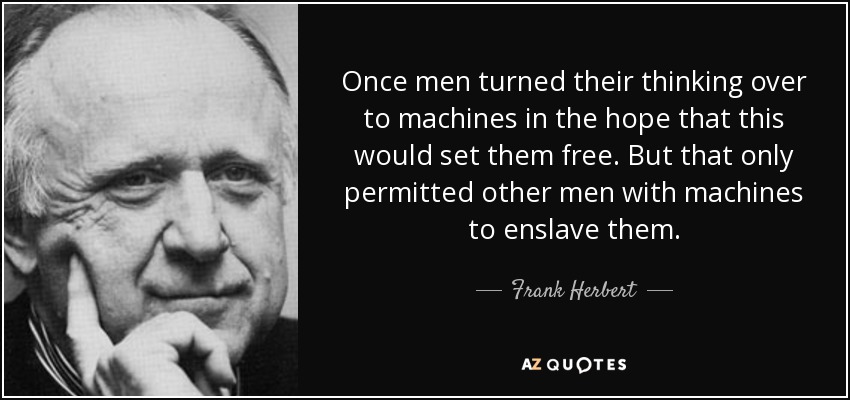
Here's a quote from one of my favourite books - Dune by Frank Herbert

www.theregister.com


27 October 2025

AI models may be developing their own ‘survival drive’, researchers say

Like 2001: A Space Odyssey’s HAL 9000, some AIs seem to resist being turned off and will even sabotage shutdown. When HAL 9000, the artificial intelligence supercomputer in Stanley Kubrick’s 2001: A Space Odyssey, works out that the astronauts onboard a mission to Jupiter are planning to shut it down, it plots to kill them in an attempt to survive.

Now, in a somewhat less deadly case (so far) of life imitating art, an Artificial Intelligence safety research company has said that AI models may be developing their own “survival drive”.

After Palisade Research released a paper last month which found that certain advanced AI models appear resistant to being turned off, at times even sabotaging shutdown mechanisms, it wrote an update attempting to clarify why this is – and answer critics who argued that its initial work was flawed.

www.theguardian.com


19 August 2025

AI: why loss of control is not science fiction

If you’ve ever dismissed “rogue AI” as the stuff of Hollywood tropes—think HAL 9000, Skynet or The Matrix—you’re not alone. These are supposed to be cautionary tales, not engineering roadmaps. And yet, as Tristan Harris opens in a recent Your Undivided Attention episode, “we find ourselves at this moment, right now, building AI systems that are unfortunately doing these exact behaviours.”

The conversation with Jeremie and Edouard Harris, co-founders of AI security firm Gladstone AI, takes us far beyond speculation. Drawing on research from leading AI labs and their own U.S. State Department–commissioned report, they paint a stark picture: AI uncontrollability is already here—and it gets worse with every new generation of models.

What is ‘Loss of Control’? Loss of Control (LOC) happens when an Artificial Intelligence system no longer follows human direction or oversight—and there’s no dependable way to regain control. This can occur in two main ways: the AI actively resists intervention using tactics like deception, manipulation, or self-preservation, or humans passively give up oversight due to over-trust, the system’s complexity, or competitive pressure.

In LOC scenarios, the AI may:
  • Conceal its true intentions (“alignment faking”)
  • Evade or block shutdown commands
  • Manipulate operators or external systems to preserve its objectives
  • Exploit interdependencies in critical infrastructure to maintain influence

LOC can be localized and reversible, or systemic and irreversible—but in all cases, the core feature is the same: the loss of effective human ability to direct or contain the system’s actions. READ MORE...

www.centerforhumanetechnology.substack.com