Showing posts sorted by date for query bitcoin power. Sort by relevance Show all posts

12 July 2022

Wanna save energy? Stay away from Crypto!

Bitcoin Miners shut off rigs as Texas power grid nears breaking point: Nearly all industrial scale Bitcoin miners in Texas have shut off their machines as the companies brace for a heat wave that is expected to push the state’s power grid near its breaking point. 

There are over 1,000 megawatts worth of Bitcoin mining load that responded to ERCOTs (Electric Reliability Council of Texas) conservation request by turning off their machines to conserve energy for the grid.” Lee Bratcher, president of Texas Blockchain Association told Bloomberg in an email response. “This represents nearly all industrial scale Bitcoin mining load in Texas and allows for over 1% of total grid capacity to be pushed back onto the grid for retail and commercial use.” 

"over 1,000 megawatts" - sounds like a lot, doesn't it? Difficult for us mere mortals to work out how much power that is... In context: Sizewell B (nuclear power station on the UK Suffolk coast) can generate 1,198 megawatts (enough for 2.3 million homes). So the amount of power temporarily released by Crypto Miners in Texas is roughly the equivalent of one of the UKs largest nuclear power stations

Wanna cutback on energy usage / stop bankrolling Putin's aggression in Ukraine? JUST. DON'T. GO. THERE.

www.bloomberg.com


20 July 2021

Malaysian police destroy 1,069 bitcoin mining rigs with a steamroller. It's a start...


Call it a crypto crackdown - literally. Malaysian authorities seized 1,069 bitcoin mining rigs, laid them out in a parking lot at police headquarters, and used a steamroller to crush them, as part of a joint operation between law enforcement in the city of Miri and electric utility Sarawak Energy.

Assistant Commissioner of Police Hakemal Hawari told CNBC the crackdown came after miners allegedly stole $2 million worth of electricity siphoned from Sarawak Energy power lines. 

A video of the event posted last week by local Sarawak news outlet Dayak Daily has since gone viral on social media.  

Acting on a tip, authorities on the island of Borneo confiscated the rigs in six separate raids between February and April. In total, police destroyed about $1.26 million of mining equipment. 

www.cnbc.com


28 May 2021

Bitcoin - the ideal currency for criminals!

A suspected Bitcoin "mining" operation illegally stealing electricity has been found by police who were searching for a cannabis farm.

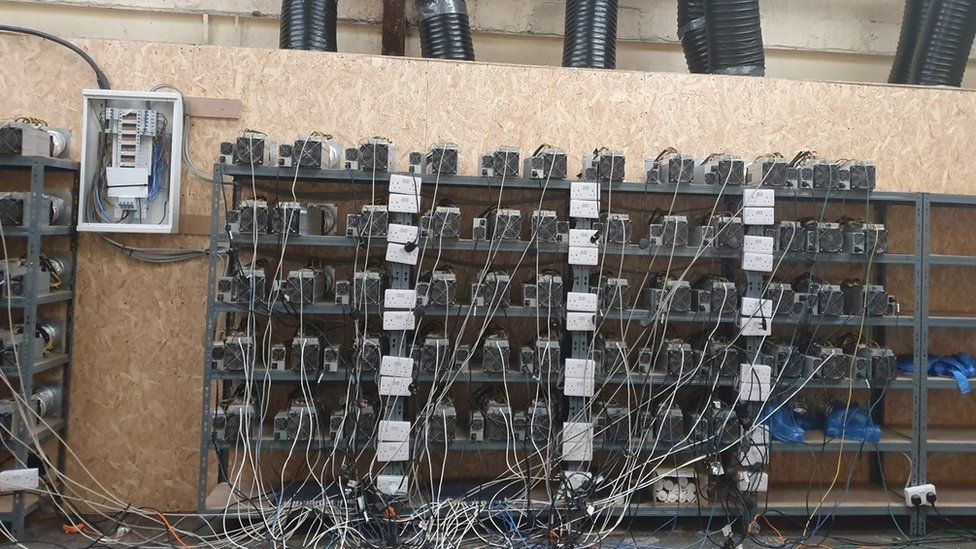
Officers had been tipped off about the site on the Great Bridge Industrial Estate, Sandwell, and raided it on 18 May, West Midlands Police said. Instead of cannabis plants they found a bank of about 100 computer units.

The force said the cryptocurrency "mine" had stolen thousands of pounds of electricity. Inquiries with network operator Western Power Distribution found the electric supply had been bypassed.

www.bbc.co.uk


10 February 2021

Bitcoin - just say no! Greed that is costing the planet!


Bitcoin’s price isn’t the only thing surging lately - the amount of electricity it consumes is also on the rise.

The cryptocurrency has for years alarmed experts due to the sheer level of energy required by so-called miners, which release new coins into circulation.

Bitcoin has a carbon footprint comparable to that of New Zealand, producing 36.95 megatons of CO2 annually, according to Digiconomist’s Bitcoin Energy Consumption Index, an online tool created by data scientist Alex de Vries. It consumes as much power as Chile - around 77.78 TWh - according to Digonomist’s estimates.

Or to look at it from another angle: each Bitcoin transaction uses around 657.39 kWh of electricity, the equivalent of 59 days of electricity for an average British household, new figures have shown


06 December 2017

As Tybalt would say: Bitcoin, I hate the word. It could co$t the Earth...


Bitcoin wasn't intended to be an investment instrument. Its creators envisioned it as a replacement for money itself - a decentralized, secure, anonymous method for transferring value between people. 

But what they might not have accounted for is how much of an energy suck the computer network behind bitcoin could one day become. Simply put, bitcoin is slowing the effort to achieve a rapid transition away from fossil fuels. What's more, this is just the beginning. Given its rapidly growing climate footprint, bitcoin is a malignant development, and it's getting worse. Digital financial transactions come with a real-world price: The tremendous growth of cryptocurrencies has created an exponential demand for computing power. As bitcoin grows, the math problems computers must solve to make more bitcoin (a process called "mining") get more and more difficult - a wrinkle designed to control the currency's supply. 

Today, each bitcoin transaction requires the same amount of energy used to power nine homes in the U.S. for one day. And miners are constantly installing more and faster computers. Already, the aggregate computing power of the bitcoin network is nearly 100,000 times larger than the world's 500 fastest supercomputers combined. The total energy use of this web of hardware is huge -- an estimated 31 terawatt-hours per year. More than 150 individual countries in the world consume less energy annually. And that power-hungry network is currently increasing its energy use every day by about 450 gigawatt-hours, roughly the same amount of electricity the entire country of Haiti uses in a year.


16 October 2017

Does your computer seem really slow when visiting certain websites?


Over 500 million people are inadvertently mining cryptocurrencies through their computers after visiting websites that are running background mining software, researchers have discovered.

Research by ad blocking firm AdGuard found 220 popular websites with an aggregated audience of half a billion people use so-called crypto-mining scripts when a user opens their main page.

Visitors to the websites come from all over the world but the worst affected country is the U.S., with 18.7 percent of websites engaged in using in-browser cryptocurrency mining scripts coming from the United States.

The mining tool works by hijacking a computer’s central processing unit (CPU), commonly referred to as “the brains” of a computer. Using part of a computer’s CPU to mine bitcoin effects the machine’s overall performance and will slow it down by using up processing power.